Home Energy

Showing posts with label Cut Home Energy Costs. Show all posts

Sunday, 11 January 2015

Why Your Home Needs a Home Energy Audit

This heating season, you probably want to save money on your energy use. This is especially true during this winter's cold snap that has affected much of the country as far south as Miami and Houston. But that might not be the only reason. You might find that your home's HVAC system is always running hard but can't adequately heat your home. Or some rooms in your house seem cooler or hotter than others. Maybe you noticed a mold or mildew problem in a room other than your bathroom. Perhaps your water heater can't keep up with demand. You can fix these problems by starting with a home energy audit.

How does a home energy audit work?

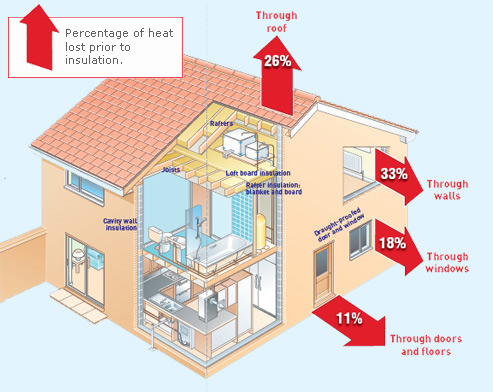
An energy audit looks at several specific features of your home. First, it lists the characteristics of your home's thermal envelope: walls, ceilings, floors, doors, windows, and skylights. Each of these features has a specific R-value, which is a measurement of the resistance to heat flow. The higher the resistance (or R-value), the better the insulative quality. Another factor is the leakage rate or how much outside air infiltrates into your home. Drafty doors and windows are the primary culprits here, however, other features of your home's construction, age, orientation to the sun, and physical condition will have an effect. A third area to look at is your home's mechanical system - the heating/ventilation/air conditioning (HVAC) as well as the heating water.

Energy Star provides a Home Energy Yardstick website so you can compare your household's energy use to the rest of the country. The site is a good place to start and gives some basic recommendations about making home energy efficiency improvements.

Generally, performing your own energy audit will help you discover most of the major energy usage problems in your house. For example, locating and sealing air leaks will help you save money and make your home more comfortable. An easy way is to wet your hand and then feel for drafts around:

* Electrical outlets
* Switch plates
* Window frames
* Baseboards
* Weather stripping around doors
* Fireplace dampers
* Attic hatches
* Wall or window-mounted air conditioners.

Look and feel for gaps where pipes and wires enter a wall. Also check where your floor meets the foundation. And don't forget mail slots. Check to see if caulking and weather stripping are applied properly and in good condition.

Every house and lifestyle, is different. It's safe to say that climate and location are primary factors in how your home performs. The other major factor is how you use energy in your home. When combined with information about local weather, the home's thermostat settings, as well as energy bills for a 12 month period (24 is more accurate), an energy audit can render a more accurate picture of how your home uses energy.

Unless you already have a few years experience of belly-crawling the dusty, cramped spaces of your home to weather-seal it, you should consider having a professional visit and perform an energy audit. Now you might think all an energy auditor does is seal a fan onto your front door and then prowl your house looking for drafts. Sure, they might perform this test, but not only do you get the benefit of their years of training and experience, you also gain from a fresh perspective.

Professionals can often see things you have overlooked that can help you save on your energy costs and be more energy efficient. For example, a slight discoloration along a corner of your living room wall might indicate an unsealed gap in your home's framing that lets in cold air and moisture. This and other hidden heat loss can also be detected with heat-sensitive cameras, a tool most homeowners don't own.

A qualified energy auditor can also give you an informed choice of options. Some fixes might just require a tube of $4.00 caulk to save you $100.00 in energy costs. Some fixes might be more expensive but can be done over time. An energy auditor can make recommendations for improvements and solutions based on what they learn about your living habits, needs, and budget. This can include efficient low-wattage lighting fixtures, getting the best insulation for your buck, as well was Energy Star rated appliances and upgrades so you can take advantage of both Federal and State rebate offers.

Remember, not only will an energy audit show you where to start saving money to heat your home this winter but it will identify cooling problems that cost you during the hot summer months. But whether or not you decide to do it yourself or consult a professional, you should do it as soon as possible so you can identify your home's problems and develop a plan of action. After all, making your home energy efficient not only saves money, energy, and natural resources, it also makes your home more comfortable and enjoyable for you and your family.

Source: http://www.artipot.com/articles/531597/why-your-home-needs-a-home-energy-audit.htm

Sunday, 21 December 2014

Learn 8 Easy Steps to Reduce Your Home Energy Bill And These Will Not Cost You a Dime

Before you think about adding renewable energy sources to your home, it may be a good idea to cut down on your home energy usage first. That sounds logical as not doing so is like leaving the windows open while the A/C is running! Maybe that is a stretch but I think you get the point. If you are thinking of adding solar or wind energy to your home, cutting down on your energy usage will only reduce your renewable energy investment.
Change Your Daily Habits: Sometimes the most difficult things to change lie between our two ears. Most of us probably did not arrive overnight at the bad habit of leaving the lights on while no one was in the room, or even worse...not even home. Yet, changing our daily habits can make a significant impact on home energy usage. And the best part, they do not cost us a dime.
1. Reduce Light Use - One of the easiest ways to cut energy costs is to live by the rule: one light on per person in the house. If that is a stretch for your family, challenge them by turning off unused lights until you get down to one light per person. Make a game out it and give a reward to the person who uses the least amount of lights. Sometimes, taking baby steps is the best way to go. And those small changes year-over-year will begin to add big dollars to your bank account.
2. Keep Unused Rooms Closed - There is no need to cool or heat rooms that are not in use such as the attic, basement or laundry room. Close doors and vents in unused rooms to keep the comfortable temperatures where your family is...and at a lower energy cost.
3. Close Garage Door - All day and night the house is either heating or cooling the garage so think twice before sending this stored energy to the wind...keep it! The garage is a form of insulation, and a good idea to keep in mind since heating and cooling costs can count for up to 25% of your energy bill.
4. Close Up Unused Fireplaces - since hot air rises, this is a more important rule in the wintertime. Opened fireplaces will create a natural vent for your hard earned heating dollars to escape.
5. Adjust Thermostat - adjusting the thermostat by 15 degrees for eight hours can reduce your electric bill by 15%. 15 degrees seem a bit extreme...try 5 degrees for a week then progress from there. And with programmable thermostats today that allow you to set your daily and weekly programs, this can make lowering your energy bill a simple chore.
6. Window and Blinds - although this may not have been high on your energy conservation list, opening or closing your windows, blinds or even curtains can have a positive effect on your energy bill. Instead of reaching for the A/C thermostat, try opening windows instead to vent hot air in the summertime, especially the upstairs windows if you have upper floors. Even using a fan near windows to blow hot air outside can be a lower energy usage choice than the A/C. If the A/C or heater is a must, closing the blinds and curtains can be a great way to help insulate your home from the weather. An exception to this rule is if your windows face the sun in the wintertime. In this case, open the blinds and curtains to let the solar energy in.
7. Bundle up or go naked - this one was probably not on your list, at least not on any energy conservation one. Instead of turning on the heater, throw on a sweater instead. And in no time, you will save enough money to buy a new sweater. For those hot summer days, go light on the cotton. How light is up to you, but keep the neighbors in mind if you leave the blinds and curtains open.
8. Cook Outside - instead of using the stove and heating the house, try cooking outside with your barbeque during the summer months. That way the stove, or secondary heater, will not be competing with your home cooling system.
With energy costs on the rise and renewable energy sources requiring an investment in time and money, changing your energy consumption habits to cut your energy bill is the best first step for most. And why not, it does not cost you a thing!
Keith Garrett is a solar energy and wind power enthusiast for the home. His website at [http://www.solarwind4homes.com] offers knowledge and tips to the home owner on transitioning to renewable energy in the 21st century.

Source: http://ezinearticles.com/?Learn-8-Easy-Steps-to-Reduce-Your-Home-Energy-Bill-And-These-Will-Not-Cost-You-a-Dime&id=4051342

Sunday, 13 July 2014

Solar Panels for Your Home Energy Needs

Solar Panels for Your Home Energy Needs
Green energy benefits everyone, from business owners to home owners. Solar power can be used to provide power for anything electrical. Governmental support helps add popularity to an already growing phenomenon of energy conservation efforts. Solar panels for a home are designed to provide the energy required to run all aspects of a home's electrical needs, including heat. Home solar panel systems are the biggest sellers in available in the solar panel system market. To provide the ability for optimal performance, most solar panel systems have compatible accessories and equipment that a consumer can purchase with heir solar panel system. A tracker can automatically rotate your solar panels to pick up the best concentration of sunlight. This saves you from having to climb up on your roof when the seasons change and the sun's directions changes. This accessory is also a benefit to those homeowners who do not have a south-facing house. You can also add accessories that would allow you to heat the water in your pool. You would be able to enjoy consistent water temperature all year long!
More recently, the installation of solar panel systems during the construction process has become popular. This process allows a more comprehensive installation of solar panel systems, primarily because of the added stability during mounting. With an open roof, the solar panel frames can be mounted directly to the support beams of the roof which bypasses the plywood and shingles. The rest of the roof is then built around the solar panel system. The only drawback is that this type of installation does not provide optimal energy production if the solar panels are not faced in the southern direction.
If you have reservations about adding a bulky solar panel system to the top of your house, there is another solution for you. You can also purchase flexible thin film solar panels. These alternatives are so versatile that they can be placed on many services. As long as there is enough sunlight, you do not have to mount these solar panels systems to your roof. For house that do not face south, this is a good choice because you can create a space in your yard to mount these solar panel systems.

Source: http://goarticles.com/article/Solar-Panels-for-Your-Home-Energy-Needs/1347401/

Sunday, 6 July 2014

Home Energy Solutions to Cut Home Energy Costs Drastically

Do you want to cut home energy costs by over 80%? Are you looking for real home energy solutions to the rising price of oil and those monthly utility bills that are hurting your pockets? Here is a review of how creating your own home energy can almost eliminate your utility costs and put more money into your pocket.

Solar Energy and Why It's so Effective
Among the best home energy solutions available right now is the use of solar energy. You've probably seen solar panels posted up in nearby neighborhoods or on the corners of streets where government buildings or libraries are located. Solar energy panels are so effective and so clean that the government is now talking about making it standardized within the next decade. A panel of sorts to energy and get from the rays of the sun and stores it into a converter full of photovoltaic cells. This energy is stored there in this converter for later consumption. Even if it's not sunny outside you can potentially have enough solar energy stored in your converter to give you enough energy for your home for over a week. All it takes is for you to expose your energy panel to the sun for at least 12 hours on only one very day or (roughly sun up to sun down) to store enough energy for several days. This can cut home energy costs by a drastic 80% or more each month.

Home Energy Solutions for Combating Rising Costs
You're probably wondering how you can even get a solar panel. Well, there are number of commercially sold panels that are being marketed right now and if you have at least two thousand dollars or more, you can get your hands on one and have them install it at your home. Or, you can go to more effective and cost friendly route such as I. You can build your own solar panel and put it up yourself for under $200 tops! All with equipment for doing so can be found at places like Home Depot and Lowe's. If you're serious about implementing home energy solutions that can help you cut home energy costs substantially each month, then save yourself $200 and build your own solar panel in just hours.

Article Source: http://EzineArticles.com/1984737