Home Energy

Showing posts with label Home Energy Consumption. Show all posts

Sunday, 30 November 2014

Aspects of a Full Home Energy Audit

Many homeowners are looking for ways to make their home more energy efficient and save money on their utility bills. Often times the energy company that performs a free home energy audit only checks obvious areas like lighting and air sealing.

It is important that your home energy auditor performs a complete home energy audit. Vital aspects of your home that should be checked in a home energy audit include:

*Heating and cooling system: Learning about the energy efficiency of your heating and cooling system is essential. If this is not checked there could be an abundant amount of energy being lost that you do not even recognize. Heating and cooling accounts for a large amount of energy use in your home and can be a major source of energy loss as well. Getting a complete home energy audit that assesses your heating and cooling system is something that you don't want to go without.

* Sealing: Although air sealing throughout your home is an obvious check, make sure it fully evaluates the air sealing. Simply checking around windows is not enough for your energy audit. A proper one should check for air leakage in your attic, foundation, and around any vents that may be letting in unwanted air.

When places are found throughout your home that are not sealed properly, it should suggest fixes such as insulation in the attic or basement, caulk and weatherstripping around doors and windows, and foam gaskets behind outlet and switch plates on walls. These fixes will keep in the conditioned air so that you are not wasting energy heating or cooling the outside, unconditioned air.

* Insulation: They are only complete when the insulation in your home is fully assessed. Many homeowners believe they have enough insulation in their home when this may actually be a major cause of energy loss. Simply checking to see if there is enough insulation is not a complete energy audit either though. Assessing your insulation r-value is essential.

The r-value of your insulation determines how well your home is insulated. This value depends on the type insulation that is in your home. A full one will assess this and let you know if you need to improve the insulation in your home to save energy and money.

* Lighting: Lighting is a simple fix, but is not always addressed in a free home energy audit. A proper one should be extensive and definitely address the lighting in your home. With new lighting technologies, the energy you use for lighting could be reduced by 50-75%. Installing energy efficient compact fluorescent light bulbs (CFLs) throughout your home will save energy and money every month.

* Appliances: It should also include an assessment of the appliances you already have and the way that you are using them. Dishwashers, refrigerators, washing machines, and dryers all must be checked out to achieve a proper understanding of the energy you are already using. When that is established, your home energy auditor should then be able to give you solutions to save money when it comes to your home's appliances.

All in all, it is extremely important that you receive a whole-house energy audit to discover your home's energy efficiency and ways that you can save money. If it looks appealing, make sure that the auditor addresses all aspects of your home and fully assesses every area where you could possibly be losing energy.

Source: http://www.artipot.com/articles/1112441/aspects-of-a-full-home-energy-audit.htm

Sunday, 9 November 2014

Performing a Quick and Easy Home Energy Audit

In recent years most of us have been plagued with rising energy bills. In many cases energy bills have risen to such an extent that they are causing financial hardship. Our dependence on fossil fuels, which are non renewable, will cause energy prices to rise even further in the future. There are many simple common sense actions that can be taken to reduce energy costs and consumption. These can range from replacing the incandescent bulbs with energy efficient fluorescent bulbs to simply turning down the thermostat. Heating and cooling costs account for the greater part of most energy bills. Most new homes are built to be energy efficient but many older homes have not been upgraded for energy efficiency. Many older homes are drafty and lack sufficient insulation. For older homes auditing your homes energy is a must. There are many companies that do these audits but they can be pricey. A home energy audit can be done easily and can be the first step in identifying problem areas that are costing energy and money.

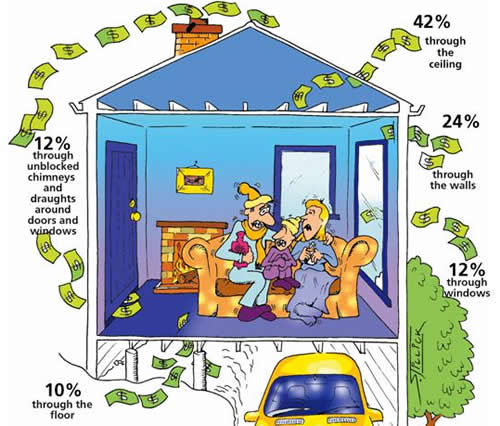
A home energy audit will help to determine the efficiency of your home's heating and cooling systems. It will also reveal how to reduce waste and conserve those valuable energy dollars. The first step in any home energy audit is to determine where energy is escaping unused. Reducing drafts in a typical home can result in energy savings of 5% to 30%.

Checking for drafts is relatively easy. Checking windows, baseboards, electrical sockets, fireplace dampers, doors, and other obvious places will probably reveal several places where simple repairs will solve the problem. Checking the exterior of the building is a very important of any home energy audit. Checking exterior corners, foundation areas, and places where chimneys and siding meet will often reveal gaps that can be easily caulked or repaired.

One of the most important parts of any home energy is checking for adequate insulation. Many older homes are woefully under insulated. Insulation has what is known as an 'R' value. Be sure to check for the recommended 'R' value for your area. Check in all the obvious places like the attic and walls. Look for gaps and make sure there is a vapor barrier. A well planned and thorough home energy audit will show where energy is being wasted. Develop your own annual home energy audit that fits your own needs. Then take the necessary actions and start saving money!

Article Source: http://EzineArticles.com/2862192

Sunday, 14 September 2014

10 Do it Yourself Steps to Home Energy Savings

With the current slump in the economy, it seems that everyone is looking to save money and cut expenses wherever they can. A potential savings that's overlooked by a lot of people is home energy conservation. While there has been a lot of talk of renewable and alternative energy sources, there are several, easy "do it yourself" projects that can add up to big savings on your energy bills. I've put together a list of 10 that only scratches the surface of ways to cut back on consumption.


1. Add and Improve Insulation- Insulation may be the single most important element of energy efficiency. It is critical that you have sufficient coverage in the key areas, which include: walls, ceilings, floors, and attics. The most obvious place to start is the attic and ceiling, which in many cases are are the same. Unless your home is extremely old (more than 50 years), chances are, there is some amount of insulation in the attic or ceiling. Adding more will only help to block the heat or the cold from spreading to the living spaces inside the home. Adding additional insulation to the attic is a, fairly, easy job if it is accessible. The most common type to add will be fiberglass batts, which come in various lengths, widths, and thicknesses. The width and thickness are made to accommodate various wall and ceiling cavity sizes between studs, rafters, and ceiling joists.
However, when adding insulation in an attic, this, most likely, won't be a factor, since you'll be laying it over the existing. The other option is blown insulation, which is a loose material that is by use of a blower. While this provides good coverage, it is a messier and more complicated process. But if you're up for the challenge, you can buy the insulation and rent the blower in some hardware and home improvement stores. Insulating walls in existing homes is a little more challenging due to the fact that the wall cavity has been covered up with drywall or other wall coverings. The expense and work associated with opening up the wall is probably not worth it unless you have an older home with no wall insulation. There is one option that I used on garage that we were converting into a bedroom. At the top of the wall, near the ceiling, we cut holes roughly 6"x6" between each of the studs in the exterior walls and blew in the insulation. We then repaired the drywall in the small spots rather than replacing it on the entire wall. If your home is built above the ground with a crawl space or if you're in a mobile home, it's important to be sure that the floor is properly insulated. This will not be an easy job because it will involve either removing the flooring to work from above or crawling on your back from below. Both of these options involve a lot of work, but if the floor is not properly insulated, heating and cooling the home will be extremely difficult.

2. Attic Ventilation- Proper attic ventilation is critical to efficiently heating or cooling your home. When hot, cold, or moist air remains trapped above the ceiling it will travel into the home below even if the ceiling has been insulated. Ventilating the attic can be accomplished several ways and the better the ventilation, the better and easier the air comfort below. The most common methods are soffit, ridge and turbine vents. Even if you're not familiar with the terms, chances are, you've seen these before. Soffit vents are found in the eves around the perimeter of the house and may be small louver type or continuous with a screen. Soffit vents usually work in conjunction with roof turbines and gable vents to move a flow of air through the attic space, thus, bringing the temperature up or down with the outside air. Ridge vents are long plastic vents that are put in place of the decking running along the ridge at the peak of the roof. If you want even better ventilation, you can install roof or gable mounted vent fans, which are controlled by a thermostat that automatically turns the fan on or off at set temperature levels in the same manner as a central HVAC system. The cans can be electrically wired or solar powered with the cost of the fan itself running between $70 and $500.

3. Install Radiant Barrier- The installation of radiant barriers has become an increasingly popular method of reducing energy consumption. The process involves installing a reflective material on the under side of the roof that will then reflect the majority of the sun's radiant heat. There are several different products available. The most common and effective being a foil strips that can be attached to the bottom side of the roof either between of over the rafters. If you are building a new home or replacing an existing roof, there is plywood decking that comes with the foil already attached to one side. There are several types and manufacturers of the foil to fit different applications and budgets. I recommend doing some research before buying. There are also radiant coatings and paints that can be brushed, rolled, or sprayed on and, while the consensus is that the paints don't offer as much benefit as the foil, it will help and the installation process may be easier.

4. Manage Power to Electronics- While the modern home electronics available today offer great convenience and entertainment value, they are some of the biggest users of electricity. Managing the power to computers, televisions, and gaming systems can reduce your energy costs more than you might think. Computers are some of the biggest power hogs. Adjusting the settings to send it to sleep mode or turning it off when you're not using it will help, but it will still use a small amount of power. Unplugging the machine altogether or using a timer to completely shut off the power will make a huge difference. Plasma and LCD TV's as well as gaming systems burn lots of electricity, spending a little more for models with the "Energy Star" rating will pay for itself. In addition, have a talk with the family about turning everything off when it's not in use. I know, in my house, it's not uncommon to have 3 or 4 TV's on at once while everyone is outside.

5. Using Energy Efficient Lighting- The use of compact fluorescent light bulbs has become very popular in the last few years and only use 30% to 40% of the power of incandescent bulbs. They are available in a variety of sizes and strengths and are also now available in dimmable bulbs. I replaced 95% of the bulbs in my house with these and saw about a 30% decrease in consumption immediately. While the price is significantly higher than incandescent, they should last 7 to 10 times longer and will quickly pay for themselves in energy bill savings. You can find much better prices by buying in bulk online. If you are replacing light fixtures or ceiling fans, there are a variety of energy efficient products to choose from.

6. Replacement Windows- Your home's windows can make a huge difference in the amount of energy that is needed to heat or cool the home. Replacing existing windows with new energy efficient models may provide a huge savings. However, it can also be extremely expensive. I recommend a good deal of research and shopping because prices vary greatly. It's also important to weigh the cost of the windows against the potential savings to see how long it would take them to pay for themselves. Building codes, for the past few years have mandated the use of double insulated windows. So, if your home was built within the last 10 years, there's a good possibility you have insulated windows. Another more cost effective method of shielding the home from outside temperatures is tinting the glass or using window coverings such as heavier draperies, shades, or shutters.

7. Weather Stripping and Sealants- This is pretty basic, but often neglected. Cracks around windows, doors, and other wall penetrations are a constant source of energy loss. Caulking or sealing cracks around windows and doors will do wonders for keeping outside air from entering the home. It's also important to be sure that all exterior doors are properly weather stripped. If the weather stripping has become loose or defective, there are a variety of replacement products available at hardware and home improvement stores. One of the most crucial places to check are access doors to attics and basements.

8. More Efficient Water Heating- Heating water is one of the biggest energy expenses in any home. For bathing, washing clothes, dishes, and sometimes swimming pools, we are almost constantly heating water. There are several measures that can be taken to reduce this cost. An easy and inexpensive method is to further insulate the tank and pipes where the enter and leave the tank. Lowering the temperature setting on the heaters thermostat, will reduce the workload while still providing comfortable water temperature. If you live in warm climate states, installing a solar powered water heater may be an option and there are installation instructions available on the internet. On demand or tankless water heaters are available in electric or gas models and will provide a saving on energy costs. However, with addition circuits or gas lines needed, the installation cost may out weigh the savings.

9. Proper Maintenance of the Heating and Cooling System- Insuring that your home's heating and cooling system is operating at peak efficiency can make a big difference in how hard and how much your system has to work. Regular cleaning and maintenance will also save you money by extending the life of your system. A couple of things you can do as a homeowner are to regularly change the filters and clean the coils and materials for this can be found in hardware, home improvement, and even grocery stores. I would also recommend having a professional technician clean and inspect the system at least once a year.

10. Government Grants and Tax Credits- With the nationwide emphasis on energy conservation, the federal government, as well as many state and local governments, have established grant programs or tax credits for making energy efficient improvements to homes and businesses. If you qualify, this could amount to hundreds or thousands of dollars in addition the the savings in energy costs. Check with the department of energy or agencies in your state to see what is available.

Article Source: http://EzineArticles.com/2465040

Sunday, 24 August 2014

What Can Home Energy Audits Do for Homeowners?

Many property owners decide to hire an auditor to perform a home energy audit. There are many good reasons to have an audit done on your home. Despite their growing popularity, many homeowners still dismiss the potential of home energy audits. Believe it or not, there are a number of benefits to having a home energy audit performed on your home, and they aren't all focused on the environment.

Does Your Family's Green Living Measure Up?
The environment isn't the only reason to have a home energy audit performed, but it is one of the biggest reasons homeowners do it. The home energy audit will help your family determine where they can improve to live greener and cleaner. The addition of an Energy Star certified product, for example, can help lower your household's overall consumption. A home energy audit can also provide information on things that can be changed or added to your home to reduce waste and stay eco-friendly.

Lower Utilities Bills Can Help You Enjoy the Other Side of Green Living
There is another side of green living that your family can benefit from. This green is the color of money rather than Mother Nature. A home energy audit can show you which utilities you may be over-consuming. It might not be due to actual use, but rather another issue. For example, a home energy audit could advise you of an appliance that needs replaced, such as an old electricity-devouring A/C unit or hot water heater. The auditor can provide suggestions for energy efficient replacements. The home energy audit results can help you find ways to live comfortably while keeping more green in your bank account.

Move Away From the Grid
A home energy audit can also help you come up with ways to live more independently and less dependently on the "grid". In this case, we are talking about more than just electricity, although that is a good place to start. Some families have solar panels installed so they can supplement their current power source or possibly wean themselves off of it completely. Wind power is another popular choice, depending on where you live. Home energy audits are the first step to improving the way your family lives.

Do Your Homework Prior to the Home Energy Audit
Before hiring a company to perform your home energy audit, do a little research. You do not have to turn into an expert, after all that is why you are hiring a professional. However it can help to know what a home energy audit will include. Most services offer clear information on what is covered and areas where your home might need improvement. For example, most home energy audits will include vital household components such as the furnace, hot water heater and air conditioning and insulation.

The home energy audit focuses on more than just energy consumption. It can also assist you with information on your home's indoor air quality and overall comfort.

Get Funding for Your Home Energy Audit
Many people are not aware that they can actually receive funding for their home energy audit from the government. The amount and eligibility requirements will vary from one location to another, however in Ontario homeowners can receive up to $5000 in grant money for improvements they make to their home that improve its energy efficiency. Learning about available grant money should be your second step prior to hiring a company to perform an energy audit on your home.

You could wind up saving much more than you spent on the home energy audit inspection in the long term. Follow the suggestions and instructions of the auditor and you will begin to notice a decrease in utility bills. The home energy audit can also give your home more appealing qualities to entice buyers should you decide to sell in the future.

Source: http://www.artipot.com/articles/1360953/what-can-home-energy-audits-do-for-homeowners.htm

Sunday, 27 July 2014

What Are the Different Home Energy Savings For Seattle Residence?

As the problem on global warming and depletion of energy sources continue to haunt nations, more people are becoming aware of energy saving. Various states have initiated efforts to tap renewable sources of energy and teach the public on how to lessen their energy consumption whether at home or at work. States have come up with laws and incentives to encourage the public to save energy. One state that continuously supports energy saving is Seattle. The different home energy savings for Seattle residence are proven helpful in reducing energy consumption as well as environment pollution.

Many tips on home energy savings for Seattle residence recommend conducting your own home energy assessment or commonly known as home energy audit. This allows you to detect how much energy your home consumes and take the necessary steps to lessen energy consumption in order to make your home energy efficient.

A home energy audit can check the different areas of your home and point out where you are using more energy. Aside from assessing your energy consumption, the home energy assessment can also give you ideas on how to save on electricity and water. Check air leaks or drafts in your window frames, baseboards, electrical outlets, mail slots and attic hatches among others. Air leaks create heat loss. Experts indicate that you can save as much as five percent to thirty percent in your energy consumption every year by simply fixing these air leaks.

Aside from air leaks, proper home insulation also helps in conserving energy. Inadequate insulation also results to heat loss and a primary reason of energy waste. Various cooling and heating equipment account for the majority of any home's energy use. Clean them annually and check it for any damage. It is also advisable to change your furnace filters at least once a month. You can also clean and seal all your home heating ducts. Furthermore, check the wattage size of the light bulbs used in your homes. Energy coming from lighting takes up ten percent of the electric bill. To save money and energy as well, change your light bulbs into compact fluorescent lamps or energy efficient lamps. Nowadays, more homes opt to use solar energy by installing photovoltaic cells on their roofs.

Home energy savings for Seattle residence does not only involve saving on electricity. It also includes water conservation. Over the years, the world has witnessed the scarcity of clean source of water. By saving on water and using water wisely, the next generation is assured of a steady supply of safe and clean water. Simple steps like turning off the faucet while brushing the teeth or fixing water leaks in faucets can make a big difference. Other ways to save water include upgrading toilets into water efficient models, keep the water used for washing fruits and vegetables and used it to water the plants, tightly turn off faucets after every use and shorten the time you spend in the shower to name a few.

These home energy savings for Seattle residence are intended not only to save on energy but also help the public to save more money. It also contributes to a cleaner environment by eliminating pollution.

Source: http://www.artipot.com/articles/1406022/what-are-the-different-home-energy-savings-for-seattle-residence.htm

Sunday, 22 June 2014

Energy-Saving Tips Inside Your Home

Home energy consumption is one of the main problems of people today. The fact is, we all need electricity to power our lives. We need the level of civilization that can be provided by electricity. However, most people think that the price they pay is just too much for the amount of electricity they get to consume. In the true spirit of humanity, people did what they always do whenever there's something that does not completely satisfy them about life: they innovated. 
Think about the paint you are going to use on your exterior walls and consider insulating paint as a radiant barrier coating. It can be purchased ready mixed or as an additive that is compatible with any interior or exterior paint. These paints are an efficient way of forming an effective thermal barrier and therefore doing alot to bring up your home's R-Value and cutting utility bills by as much as 50% Whether living in a new or traditional home, all these products can be included in your plans to save home energy and may make you eligible for tax credits Any family that is serious about saving energy in their home needs to investigate the options of energy saving exteriors.


Source: http://www.youtube.com/watch?v=kGAOZllghYo

Sunday, 1 June 2014

The Reality Behind Home Energy Consumption

Expert Author Jess Petroski"Expensive" is just one of the words that people today use to describe electricity bills. It seems that every day, the cost of electricity keeps getting higher and higher. Because of this, home energy consumption needs to be a top priority for any household, especially these days with times as tough as they are.
New energy technology, of course, takes some time to perfect. In the meantime, there are a lot of do-it-yourself home improvement projects you can do to minimize your home energy consumption with small adjustments to your home in order to improve its energy efficiency.
When you use the air-conditioning system or the furnace, maybe you shouldn't turn the thermostat up so high. It's not like you are living in the equator or the North Pole, for crying out loud. And when you go out of the house, you do not really need to keep your air-conditioning on, do you? Think of how much you will be able to eliminate from your home energy consumption by just turning these appliances off when you are not using them.
What about the kitchen? Kitchen appliances count for 26.7 percent of home energy consumption. Of course, you can't really turn off your refrigerator when you are not home, could you? Don't panic, however, there are a lot of alternatives in order to help you reduce your electricity bill. Leaving the refrigerator door open increases your home energy consumption, so don't leave it hanging open while you spread the butter on your toast in the morning. Heat rushes inside the refrigerator which means that the fridge has to consume more electricity in order to maintain its internal temperature. If you leave the door open, you are wasting electricity and increasing your home energy consumption.
The energy of information administration of the US department of energy has recently concluded a survey on the home energy consumption of US households during the year 2001. Through this data, we can at least gain an insight of which appliances are costing us. At the top of the list, of course, is climate control. Would you believe that American households consume 355.7 billion kWh just to keep themselves cool or hot? That's 31.2 percent of the total home energy consumption! Do you really need to consume so much energy just to feel hot or cold?
Water heating cost US households 104.1 billion kWh in electricity. Cutting down on the time you spend in a hot shower can cut down on your water heating bills.
As a matter of fact, there are solar heaters out there which not only save electricity by using solar power to heat your water, but these can also be connected to power small appliances. If everyone just invested in these ideas, people would be able to lessen their home energy consumption considerably.
There are a lot of easy ways you can cut back on your home energy consumption. Just by exerting a little effort, we can save a lot of our money. Did you realize how much energy our homes consume just because of wastefulness?

Source: http://ezinearticles.com/?The-Reality-Behind-Home-Energy-Consumption&id=1746978

Sunday, 25 May 2014

Your Basic Guide to Home Energy Systems

Home energy systems primarily are associated with the sun. The most popular residential energy system is the conversion of solar energy for electricity or water heating. There are two main types of solar energy, light and thermal. Light energy, from the sun, is harnessed by a collecting medium then transformed into electricity. Thermal energy, which is derived from the heat of the sun, is used to directly warm household water and swimming pools.

A typical home energy system has four components:

1. Solar Cells - Photovoltaic or solar cells made of a semiconductor material in which sunlight is converted into electricity through excitation of electrons. These cells require protection from various environmental and mechanical elements; thus, they are encased in photovoltaic modules or panels. These modules come in different sizes, weights, and shapes.

2. An Inverter - An inverter transforms direct current into alternative current electricity.

3. Mounting System - A sturdy mounting system is imperative to secure your home energy systems atop a variety of surfaces from tiled roofs to the shiny exterior of a yacht.

4. Batteries - Batteries are optional as they served as storage for electricity produced.

Home energy systems also use semiconductor materials. The commonly used semiconductor materials in the manufacture of solar cells are:

1. Mono-Crystalline Silicon - Mono-crystalline silicon is made by the use of a crystal microtome that thinly slices the material into 150 - 350 microns thickness.

2. Multi-Crystalline - Multi-crystalline silicon is made by sawing into a block of silicon.

3. Amorphous Silicon - Amorphous silicon is produced when a thin layer of the material is placed on a substrate to make a photovoltaic module.

4. Thin film has a width of 1/10 micron, the flimsiest material to be used in solar cells.

The benefits of home energy systems are definitely extensive. Among such perks are the following:

1. There is relatively fast turnabout of capital investment now considering that solar power companies offer a minimum of a 20-year warranty and solar units can last a lifetime with proper use and care.

2. You are no longer affected by price hikes of electrical providers. You now have full reigns on the amount of electricity you can generate with your home energy system.

3. There are no taxes yet levied by the government when you harness solar radiation. You are entitled to as much sunlight as your system can get.

4. With minimum movable parts, home energy systems have low maintenance costs compared to electrical connections with their many wirings and cables.

5. Many governments actually offer incentives for people to switch to home energy systems as part of their environmentalist movement.

6. It is safe for the environment. Unlike renewable energy, solar power does not emit polluting emissions and harmful greenhouse gases such as carbon and methane. Accidental dredging and spillage seen in fossil fuel production is also not possible with solar power.

7. With home energy, there are no dangerous ecological by-products made during solar power production.

8. Using home energy helps the environment. You set a good example for your neighbors to hopefully emulate. When you use solar power energy, you actually help conserve other depleting natural energy sources like petroleum and coal for future generation use.

Source: http://www.artipot.com/articles/205748/your-basic-guide-to-home-energy-systems.htm

Sunday, 9 March 2014

Important Reasons to Have a Home Energy Check Up

Are you aware of how important and beneficial a home energy check up can be? Let me tell you indeed how significantly it can help you to save on your energy bills.

The home energy check up is an evaluation of your home that you can do either by yourself or by hiring a professional to do it. This evaluation is really important when you are trying to saving energy as it helps you determine the exact areas your home that can be improved and made more energy efficient.
In order to make the check up as effective as possible it is best completed when your whole family is present. They all need to understand and be a part of implementing the changes that need to happen. If you have younger kids it is your responsibility to help them value the energy used around the house and therefore learn to use it wisely and efficiently.

Today more and more people want to save energy around their house but they want to do it their way. Unfortunately only a few of them actually take advantage of the resources and tools available to them. Some of those are the home energy check up, the home energy yardstick and government incentives, as well as many others.
As a family unfortunately your individual efforts may be offset by another member of the family's irresponsible actions. That is why everyone in your household must be a part of the check up and work together to implement the changes. 

Here are 5 basic energy saving techniques:
1. To switch off lights when you're not in the room is an easy energy conserving technique, yet not many people take advantage of it.
2. Turn off your electronics instead of letting them sit on standby. You may assume that standby has the same energy saving potential to switching the item off but that's simply not true. The truth is that a TV on standby still consumes around 60% of the energy it uses while it is on. Off uses no energy.
3. Use the new energy efficient light bulbs. These light bulbs have a number of advantages over the typical incandescent bulbs. They last 10 times longer, consume 25% less energy, and produce a brighter, whiter light. They operate cool which means they don't waste energy in the form of heat.
4. Improve the exterior of your home. Get rid of all sources of drafts of cold air coming into your home by eliminating any cracks and holes, this can save a lot of energy. You can do this with caulking or spray foam and weather stripping.
3. Use the sun's natural heat to help heat your home. You can do this by opening your window curtains during day time and closing them at sunset. This allows your home to gain daytime heat from the sun and keep it in during the night.

Saving energy at home is not that difficult to do, yet many people are still not taking advantage of these common sense ideas that can save them money. There could be many more reasons that you need to know about your home that would make a home energy check up worth your efforts.
By completing a home energy check up you will know what you need to do to improve your home's energy efficiency. That along with the list above will allow you to make the changes necessary around your home. It is important that you realize that it is dependent on you to do the work.

Source: http://goarticles.com/article/Important-Reasons-to-Have-a-Home-Energy-Check-Up/4314796/